TWO: William Johnson, according to his own statement, "returned to Parliament by Lord Castlereagh, to put an end to it;" a judgeship.We have stated that the spirit rising again in Germany called Buonaparte suddenly from Spain, even before Soult had pursued Sir John Moore to Corunna. At Valladolid he met the Abb¨¦ de Pradt, who had risen high in Buonaparte's favour. To De Pradt, he said he began to suspect that he had made his brother Joseph a grander present in Spain than he was aware of. "I did not know," he said, "what Spain was; it is a finer country than I imagined. But you will see that, by-and-by, the Spaniards will commit some folly which will place their country once more at my disposal. I will then take care to keep it to myself, and divide it into five great viceroyships." Such were the soaring notions of Napoleon at the very moment that the man was ready who was to drive the French from Spain for ever. In England, at last, almost every one had now awoke to the consciousness that Sir Arthur Wellesley was the only man to cope with the French in the Peninsula. There were a few individuals, like Lord Folkestone, who were blinded enough by party to oppose this general conviction; but before the close of March Sir Arthur was selected by the Government for this command. On the 15th of April he sailed from Portsmouth, and on the 22nd he arrived safely at Lisbon. Some regiments of both horse and foot soon followed him, and he assumed the command of the British army in Portugal, which had been some time in the hands of General Sir J. Cradock. The command of the Portuguese troops had been placed in the hands of General Beresford, who had been actively drilling them; and thus General Sir Arthur Wellesley found himself at the head of an effective army of[574] British and Portuguese numbering twenty-five thousand men.
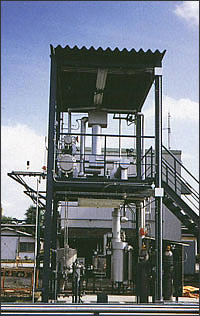
Great attention is recently being paid to global environmental issues, and it is now conceivable that companies will need to treat used solvents themselves. In consideration of this kind of social issue, we have developed a “membrane separation type solvent dehydration system,” which uses a polyimide membrane with superior dehydration properties developed by Ube Industries, Ltd. in combination with our own distillation and concentration technology that has resulted in solvents being more easily recovered.
THREE:But for Newcastle to form a Cabinet was no such easy matter. Pitt refused to take office with him unless he had the whole management of the war and foreign affairs. The king then agreed to send for Henry Fox, who accepted the office of Chancellor of the Exchequer; but Newcastle was so sensible of Fox's unpopularity that he was terrified at undertaking an Administration with Fox and without Pitt, though he was equally reluctant to let a Cabinet be formed without the former. For three months the fruitless endeavours to accomplish a Ministry went on, Parliament sitting all the time, and a great war commencing. Finally, the king and Newcastle were compelled to submit to the terms of "the Great Commoner," as they called Pitt, who became Secretary of State, with the management of the war and foreign affairs. Newcastle became again First Lord of the Treasury, but without one of his old supporters, and Legge Chancellor of the Exchequer; Holderness, a mere cipher, was the other Secretary of State; Anson was placed at the head of the Admiralty; Lord Temple was made Lord Privy Seal; and Pratt, an able lawyer and friend of Pitt, Attorney-General. Fox condescended to take the office of Paymaster of the Forces; and thus, after a long and severe struggle, the feeble aristocrats, who had so long managed and disgraced the country, were compelled to admit fresh blood into the Government in the person of Pitt. But they still entertained the idea that they only were the men, and that wisdom would die with them. One and all, even the otherwise sagacious Chesterfield, prognosticated only dishonour and ruin for such a plebeian appointment. "We are no longer a nation," said Chesterfield; "I never yet saw so dreadful a prospect."During the months of April and May Florence and all the other towns of Tuscany recovered from the revolutionary fever, and returned to their allegiance. At Bologna the Austrians met with a determined resistance. The garrison consisted of 3,000 men, including some hundreds of the Swiss Guards, who had abandoned the service of the Pope. They defied the Austrians, stating that the Madonna was all for resistance, and was actively engaged in turning aside the rockets of the enemy. But the heavy artillery did its deadly work notwithstanding; and after a short bombardment the white flag was hung out, the city capitulated, and the garrison laid down their arms, but were permitted to march out unmolested. Ancona also capitulated on the 10th, and Ferrara was occupied without resistance by Count Thurn. In fact, the counter-revolution was successful all over Central Italy, except in the Papal States, which now became the centre of universal interest. The leaders of the revolutionary party, chased from the other cities of Italy, were warmly welcomed at Rome, and gladly entered the ranks of its defenders.
- 1Under the distillation system, even in case of azeotropic solvent compositions, this system which remove water vapor by the polyimide membrane will easily dehydrate.
- 2In comparison with the distillation system, it significantly saves on use of steam.
- 3Dehydration can be performed through merely supplying evaporated vapor to the membrane module and maintaining the differential pressure between the permeable side and the impermeable side.
- 4Solvent purity of 99.9% or more can be achieved by carrying out dehydration with a polyimide membrane only.
- 5The polyimide membrane has superior heat and solvent resistance. Therefore, the vapor permeation system reduces contamination of the membrane and thus extends its life.
THREE:(After the Portrait by A. E. Challon, R.A.)Such was the busy scene which these colonies were now presenting. Dutch, German, and Swedish emigrants were carrying their industry and handicrafts thither. But, instead of our merchants seeing what a mighty market was growing up for them there, their commercial jealousy was aroused at the sight of the illicit trade which the colonists carried on with the Spanish, French, and other colonies, and even with Europe. The planters of the British West Indies complained of the American colonists taking their rum, sugar, coffee, etc., from the Dutch, French, and Spanish islands, in return for their raw produce, asserting that they had a monopoly for all their productions throughout the whole of the British dominions. Loud clamours were raised by these planters in the British Parliament, demanding the prohibition of this trade; and, after repeated endeavours in 1733 an Act was passed to crush it, by granting[184] a drawback on the re-exportation of West Indian sugar from England, and imposing duties on the importation of the West Indian produce of our European rivals direct into the American colonies.
The aromatic polyimide membrane is highly permeable to water vapor but less permeable to vapors of organic compounds such as alcohol etc.
THREE:
- 1 Recovery of the detergent solvent Recovery of the cleaning solvent such as electronic parts industry, precision instrument industry.
- 2Solvent recovery and the refinement Solvent recovery and the refinement such as chemical industry, an industry of medical supplies, food industry, the fermentation industry.
THREE:After the lapse of a week the House of Commons met again on the 13th of May, when Lord John Russell immediately rose and stated that since he had last addressed them Sir Robert Peel had received authority from her Majesty to form a new Administration; and the right hon. baronet having failed, her Majesty had been graciously pleased to permit that gentleman to state the circumstances which led to the failure. Sir Robert Peel then proceeded to detail all the facts necessary for the explanation of his position to the country. He had waited upon the Queen according to her desire, conveyed at the suggestion of the Duke of Wellington, who had been sent for by her Majesty in the first instance. The Queen candidly avowed to him that she had parted with her late Administration with great regret, as they had given her entire satisfaction. No one, he said, could have expressed feelings more natural and more becoming than her Majesty did on this[462] occasion, and at the same time principles more strictly constitutional with respect to the formation of a new Government. He stated his sense of the difficulties a new Government would have to encounter; but having been a party to the vote that led to those difficulties, nothing should prevent him from tendering to her Majesty every assistance in his power. He accordingly, the next day, submitted the following list for her approval in the formation of a new Ministry:¡ªThe Duke of Wellington, Lord Lyndhurst, Earl of Aberdeen, Lord Ellenborough, Lord Stanley, Sir James Graham, Sir Henry Hardinge, and Mr. Goulburn. It was not until Thursday that any difficulty or misconception arose to lead to his relinquishing his attempt to form an Administration. His difficulty related to the Ladies of the Household. With reference to all the subordinate appointments below the rank of a Lady of the Bedchamber he proposed no change; and he had hoped that all above that rank would have relieved him of any difficulty by at once relinquishing their offices. This not having been done, he had a verbal communication with her Majesty on the subject, to which he received next day a written answer as follows:¡ª[585]
Acetone, ethanol, methyl ethyl ketone, butanol, isopropyl alcohol, ethyl acetate, methyl isobutyl ketone, others (including hexane and toluene).
